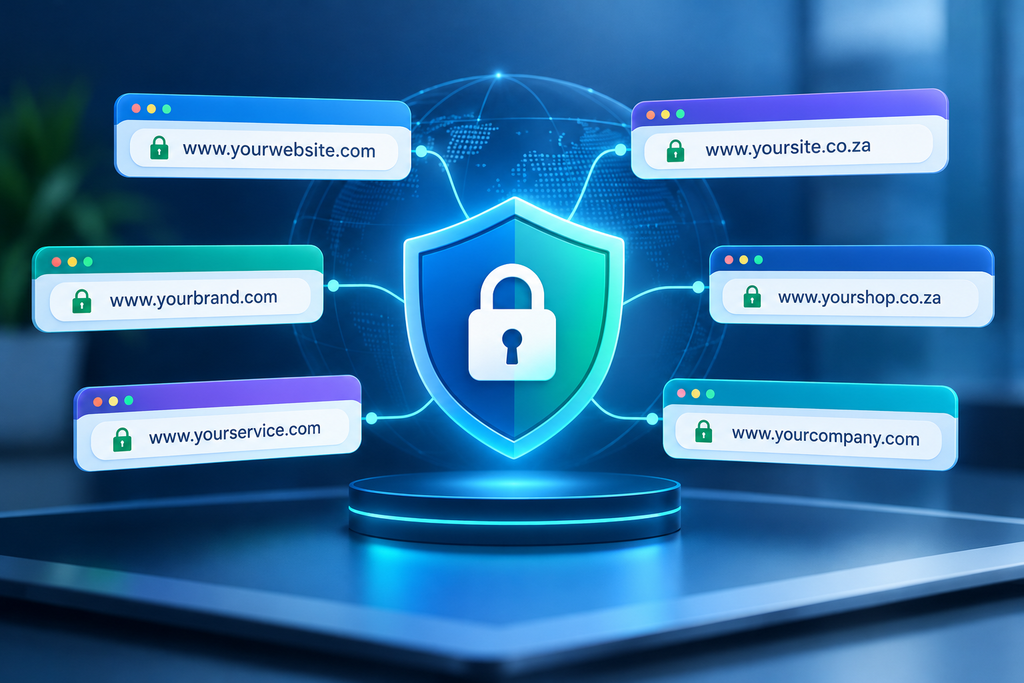
Your business runs yourbusiness.co.za. Then you register yourbusiness.com for international customers, launch a second brand and add a site for your Kenyan market. Suddenly, you’re managing four certificates, four bills and four renewal dates. A multi-domain SSL certificate replaces them all with one.
It secures several different domains under one certificate. This guide explains how it works, the signs you need one, when another option fits better, and how FastSSLArena helps you get it right.
What is a multi-domain SSL certificate?
A multi-domain SSL certificate protects multiple, completely different domain names with a single certificate. It’s often called a SAN certificate, after the Subject Alternative Name field that lists each domain it covers.
You may also see it called a UCC (Unified Communications Certificate). The name comes from its early use with Microsoft Exchange and Office Communications servers, but today SAN and UCC certificates work the same way.
For example, one multi-domain certificate could cover:
- yourbusiness.co.za
- yourbusiness.com
- yoursecondbrand.africa
- shop.yourbusiness.co.ke
How a multi-domain certificate works
When you order, you list every domain you want to protect. Each one is then added to the certificate’s SAN field, and the CA validates each domain before issuing it.
- Starting allowance: most certificates include a set number of domains, with the option to add more up to a limit set by the brand.
- Mix and match: you can include main domains and specific subdomains, such as mail.yourbusiness.co.za.
- Changes mean a reissue: to add or remove a domain, the certificate is reissued with the updated list.
- Shared timeline: all domains share one expiry date, so they renew together.
Signs you need a multi-domain SSL certificate
- You run more than one brand. Different brand names on different domains can share one certificate.
- You operate in several countries. Country domains, such as .co.za, .co.ke and .com.ng, are common for businesses expanding across Africa.
- You own variations of your domain. Many businesses register .com and local versions to protect their brand.
- You use Microsoft Exchange or similar servers. These often need several names, such as mail and autodiscover addresses, on one certificate.
- You’ve merged with or acquired another company. A multi-domain certificate brings both sets of domains under one roof.
- You need EV across several domains. Unlike a wildcard, a multi-domain certificate is available with Extended Validation.
What you gain with one certificate
- One certificate, many domains. Secure all your domains without buying separate certificates.
- Lower costs. It’s usually cheaper than buying a certificate for each domain.
- Fewer renewals. One expiry date replaces many, which matters more as lifespans shrink. Read more about renewals.
- Flexibility. Add new domains as your business grows.
- Every validation level. Choose DV, OV or EV, depending on the trust you need. Learn more about DV, OV and EV.
Multi-domain limitations to know
- All domains are visible. Anyone can view the certificate and see every domain listed, which may reveal links between your brands.
- One shared private key. If the key is compromised, every domain on the certificate is affected.
- One business identity. For OV and EV, every domain must belong to the same organisation.
- Subdomains aren’t automatic. Only the subdomains you list are covered, unless you choose a multi-domain wildcard.
Multi-domain vs wildcard vs single-domain
| Multi-domain (SAN) | Wildcard | Single-domain | |
| Covers | Several different domains | One domain plus unlimited subdomains | One domain |
| Adding coverage | Reissue with new domains | New subdomains covered automatically | Buy a new certificate |
| Validation levels | DV, OV, EV | DV, OV | DV, OV, EV |
| Best for | Multiple brands, countries or servers | Growing sites with many subdomains | One simple website |
Need both? A multi-domain wildcard certificate covers several domains and all their subdomains. However, if you only have one domain with lots of subdomains, a wildcard certificate is usually the better fit. See our single-domain vs wildcard vs multi-domain comparison.
When a multi-domain certificate isn’t the right choice
- You only have one domain. Instead, a single-domain or wildcard certificate is simpler.
- The domains belong to different clients. Agencies should keep client sites on separate certificates, so one client’s domains aren’t visible to another.
- You need to isolate high-risk sites. Payment or sensitive platforms may be safer on their own certificate.
How to get a multi-domain SSL certificate
- List your domains. Include every domain and subdomain you want covered now, and plan for growth.
- Choose your validation level. Pick DV, OV or EV based on how much trust you need to show.
- Generate a CSR. Use your main domain as the common name, then add the rest during your order. FastSSLArena’s CSR tool makes this easy.
- Validate each domain. Confirm control of every domain by email, DNS or file. OV and EV also need your company details.
- Install and test. Install the certificate on each server, then check every domain with the Qualys SSL Labs test.
Frequently asked questions
How many domains can a multi-domain certificate cover?
It depends on the brand. Most include a few domains to start and let you add more, often up to 100 or more.
Can I add domains later?
Yes. You can add domains during the certificate’s lifespan by reissuing it with the updated list. However, extra domains may carry an additional cost.
Is a SAN certificate the same as a UCC certificate?
Yes. Both names describe a certificate that covers multiple domains. UCC is simply the name used for its role with Microsoft communication servers.
Does a multi-domain certificate cover subdomains?
Only the ones you list. To cover all subdomains automatically, choose a multi-domain wildcard certificate.
Can I get a multi-domain certificate with EV?
Yes. EV multi-domain certificates are available. As a result, they’re a popular choice for businesses that need top-level trust across several domains.
How FastSSLArena can help
Managing many domains is complex enough. Securing them, however, shouldn’t be. FastSSLArena takes the effort out of every step.
- Help choosing the right setup. Multi-domain, wildcard or both? We’ll help you pick the option that fits your domains and budget.
- Options from top brands. Compare multi-domain certificates from DigiCert, Sectigo, Thawte, GeoTrust and RapidSSL in one place.
- Simple CSR generation. Our built-in tool sets up your CSR in a few clicks, no technical commands needed.
- Validation guidance. We help you validate every domain, so one missed check doesn’t hold up your order.
- Support as you grow. Adding a new domain or brand? We’ll help you reissue your certificate quickly.
- Discounted pricing. Secure all your domains at competitive rates.
More domains shouldn’t mean more headaches.
Get your multi-domain SSL certificate at FastSSLArena today.