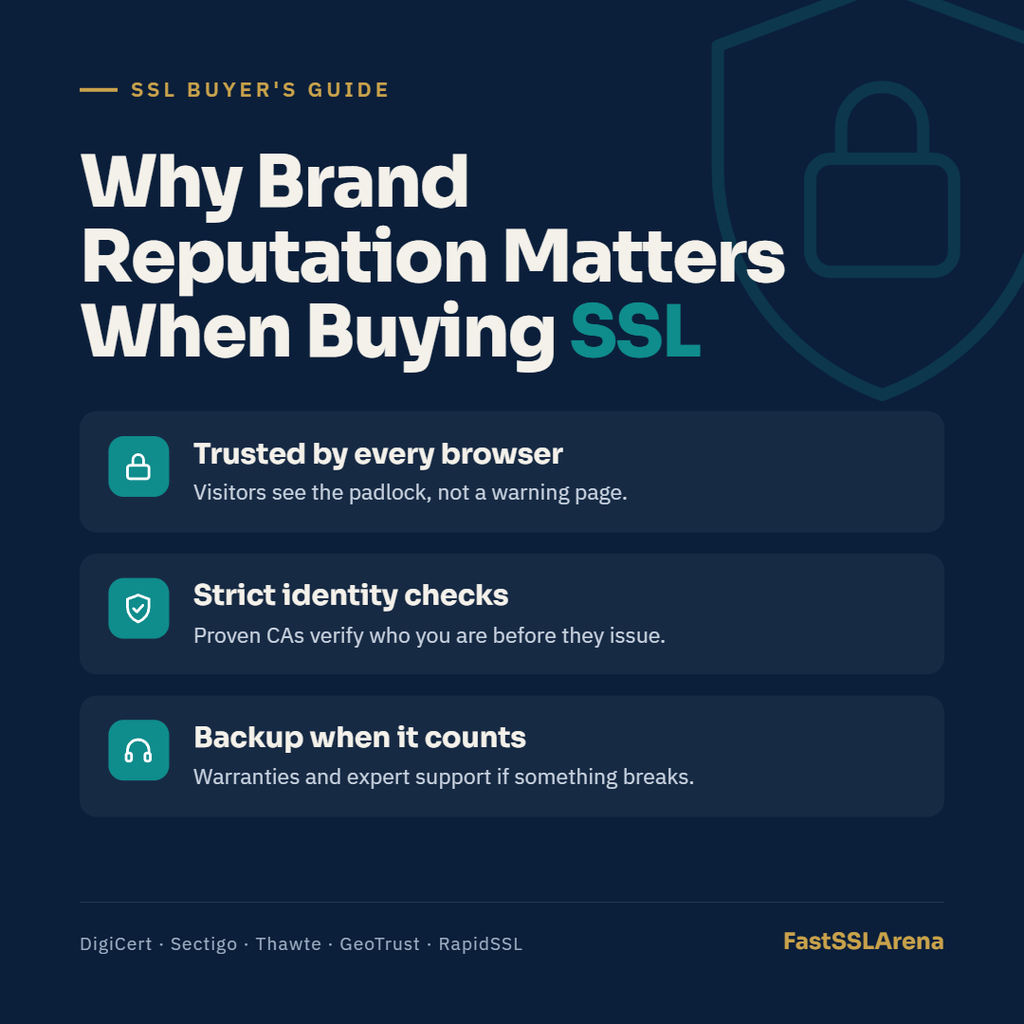
Here’s a fact that surprises many buyers: every trusted SSL certificate uses the same industry-standard encryption. In fact, a low-cost certificate scrambles data just as effectively as a premium one. So why does SSL brand reputation matter?
Because the company behind your certificate affects far more than encryption. SSL brand reputation shapes whether browsers keep trusting your site, how quickly problems get fixed and how customers and partners see your business. This guide explains why, and how FastSSLArena helps you buy from brands you can rely on.
What does reputation mean for an SSL brand?
SSL certificates are issued by certificate authorities (CAs). However, a CA’s reputation is built on more than marketing. Ultimately, it comes down to:
- A clean compliance record. Reputable CAs follow the rules set by the CA/Browser Forum and pass regular independent audits.
- Standing with browsers. Browsers decide which CAs to trust. As a result, a CA that breaks the rules can lose that trust.
- Careful validation. Strong CAs verify domains and businesses thoroughly, so certificates aren’t issued to the wrong people.
- Longevity and stability. Established brands have years, often decades, of reliable service behind them.
- Customer support. Good CAs also help you fix issues quickly when something goes wrong.
Why SSL brand reputation matters
1. Browser trust can be taken away
A certificate only works if browsers trust the CA that issued it. When a CA repeatedly fails to follow industry rules, browsers can stop trusting its certificates. If that happens, every website using that CA must replace its certificate, often at short notice. Therefore, choosing a reputable brand greatly reduces that risk.
2. Validation quality protects everyone
A CA with rigorous checks makes it harder for scammers to get certificates for domains or businesses they don’t own. As a result, this protects your customers and your brand from impersonation.
3. Support matters when things go wrong
For example, validation delays, installation errors or a lost private key can take your site offline. However, established brands offer responsive support to get you back on track quickly.
4. Warranties add a safety net
Paid certificates from reputable brands include a warranty. Specifically, it protects your customers financially if the CA makes an error when issuing a certificate.
5. Better tools for managing certificates
Leading brands also offer management platforms and automation support, which makes renewals easier as certificate lifespans shrink.
6. Partners and customers notice
Some customers, auditors and procurement teams check who issued your certificate. Therefore, a recognised brand signals that you take security seriously, which can matter in tenders, audits and enterprise deals.
Lessons from history: when CAs lost trust
Browser distrust isn’t just a theory. In fact, it has happened to well-known names:
| CA | Year | What happened |
| DigiNotar | 2011 | Hackers breached the CA and issued fraudulent certificates. As a result, browsers removed it, and the company went bankrupt. |
| Symantec | 2017–2018 | Browsers raised concerns about certificate issuance practices and phased out trust. Eventually, Symantec sold its SSL business to DigiCert, and customers had to replace their certificates. |
| Entrust | 2024 | After ongoing compliance concerns, Chrome and other browsers announced they would stop trusting its newly issued certificates. |
The lesson: a CA’s track record directly affects your website. Consequently, choosing a brand with a strong, consistent reputation helps you avoid sudden, forced replacements.
Reputation isn’t the same as price
However, a good reputation doesn’t always mean a high price. For example, budget brands like RapidSSL and Sectigo’s entry-level certificates come from highly reputable CAs. Meanwhile, an unknown provider offering certificates at suspiciously low prices may cut corners.
In short, look for a trusted name first, then choose the price point that fits your needs.
How the leading SSL brands compare on reputation
| Brand | Known for |
| DigiCert | Premium, enterprise-grade certificates and a strong reputation in finance and government |
| Sectigo | One of the largest CAs by volume, offering wide choice and strong value |
| Thawte | Decades of global recognition, with roots in South Africa |
| GeoTrust | Dependable business validation at mid-range prices |
| RapidSSL | Fast, affordable DV certificates backed by DigiCert’s infrastructure |
For deeper comparisons, read DigiCert vs Sectigo and GeoTrust vs Thawte.
How to check an SSL brand’s reputation
- Check its history. How long has the CA been operating, and has it faced distrust or major incidents?
- Confirm browser trust. In particular, its certificates should work on all major browsers and devices.
- Look for audits. Reputable CAs also publish proof of regular independent audits.
- Review its support. Then check what help is available and how quickly you can reach it.
- Buy from a trusted seller. Purchase directly through the CA or, alternatively, through a reputable reseller.
Red flags to watch for
- An unfamiliar CA name with little history or public information.
- Prices that seem too good to be true for OV or EV certificates.
- No clear validation process, especially for certificates that claim to verify your business.
- Little or no support beyond a basic contact form.
- Unclear warranty terms or none at all on paid certificates.
Frequently asked questions about SSL brand reputation
Does a well-known brand mean stronger encryption?
No. All trusted CAs use the same industry-standard encryption. Instead, reputation affects reliability, support and long-term trust, not encryption strength.
What happens if my CA is distrusted by browsers?
Visitors will see security warnings once trust is removed. As a result, you’ll need to replace your certificate with one from a trusted CA.
Are cheap SSL certificates from bad brands?
Not necessarily. Reputable brands like RapidSSL and Sectigo offer low-cost certificates. Overall, what matters is who issues the certificate.
Does the SSL brand affect my Google ranking?
No. Although Google rewards secure HTTPS sites, it doesn’t rank one certificate brand above another.
How do I see which brand issued a website’s certificate?
First, click the padlock in your browser and open the certificate details. Then check the issuer field to see the CA.
How FastSSLArena helps you buy from brands you can trust
With FastSSLArena, you don’t have to research every CA’s track record. Instead, we’ve done the groundwork for you.
- Only trusted brands. Choose from DigiCert, Sectigo, Thawte, GeoTrust and RapidSSL, all established names with strong reputations.
- Clear comparisons. See how each brand differs in price, validation and features, side by side.
- Expert guidance. Tell us about your business, and we’ll recommend the brand and certificate that fit.
- Discounted pricing. Get reputable protection at competitive rates.
- Support you can reach. Get help with validation, installation and renewals.
- Peace of mind. If industry changes ever affect a brand, we’ll help you move to another trusted option smoothly.
After all, your SSL certificate is only as trustworthy as the brand behind it. Buy from trusted brands at FastSSLArena today.