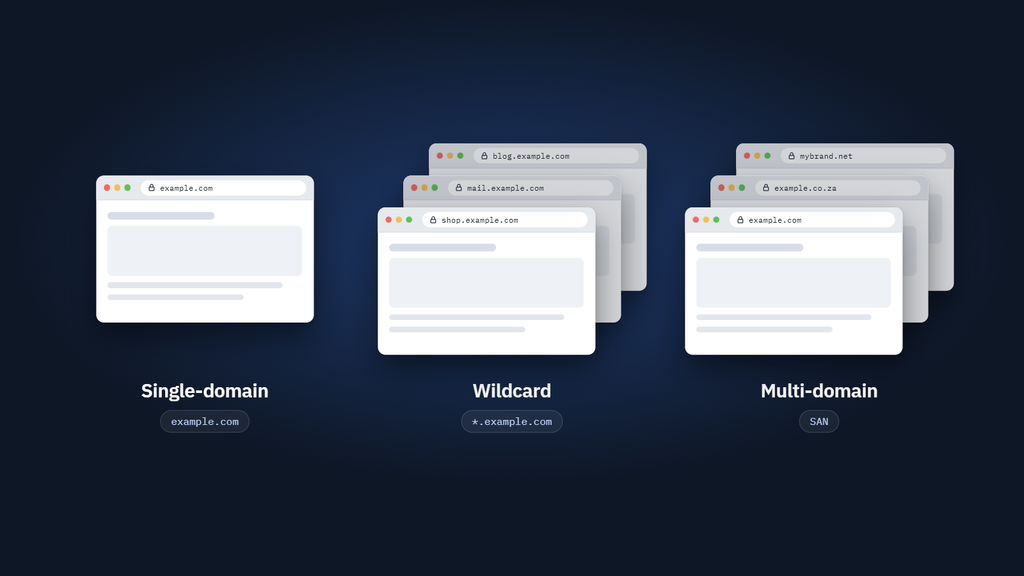
Every SSL certificate encrypts your website the same way. When you compare single-domain vs wildcard vs multi-domain, the real difference is how much of your online presence each one covers. Pick the wrong type, and you’ll either pay for coverage you don’t need or end up buying extra certificates later.
This guide compares the three types side by side, walks through real business scenarios and gives you a simple way to choose. We’ll also show how FastSSLArena helps you land on the right fit first time.
The three options in a nutshell
- Single-domain secures one domain, such as yourbusiness.co.za. Most also cover the www version.
- Wildcard secures one domain and unlimited subdomains at one level, such as shop., portal. and blog.
- Multi-domain (SAN) secures several different domains in one certificate, such as yourbusiness.co.za, yourbusiness.com and yourbrand.africa.
Single-domain vs wildcard vs multi-domain: side by side
| Single-domain | Wildcard | Multi-domain | |
| Covers | One domain | One domain plus unlimited subdomains | Several different domains |
| Example | yourbusiness.co.za | *.yourbusiness.co.za | yourbusiness.co.za, yourbrand.com |
| Adding a subdomain | New certificate needed | Covered automatically | Reissue to add it |
| Adding a new domain | New certificate needed | New certificate needed | Reissue to add it |
| Validation levels | DV, OV, EV | DV, OV | DV, OV, EV |
| Certificates to manage | One per domain | One per domain | One for all listed domains |
| Relative cost | Lowest per certificate | Higher, but replaces many | Higher, scales with domains |
| Best for | One simple website | Sites with many subdomains | Multiple brands or countries |
Five questions to find your fit
Answer these in order, and the right choice usually becomes obvious.
- How many different domain names do you own? If it’s one, consider single-domain or wildcard. If it’s several, look at multi-domain instead.
- Do you use subdomains? If you run shop., portal. or blog. sites, a wildcard saves money and effort.
- Are you planning to grow? New subdomains point to wildcard. In contrast, new brands or country sites point to multi-domain.
- Do you need EV? Wildcards don’t come with EV validation. Choose single-domain or multi-domain instead.
- Should any sites be kept separate? For example, payment platforms or client sites may need their own certificate for security or privacy.
Which certificate fits your scenario?
| Your situation | Best fit | Why |
| A local business with one website | Single-domain | Simple, affordable and covers everything you need |
| An online store with shop, blog and account subdomains | Wildcard | One certificate covers every subdomain |
| A SaaS platform giving each customer a subdomain | Wildcard | New customer subdomains are covered instantly |
| A group with brands in South Africa, Kenya and Nigeria | Multi-domain | Secures .co.za, .co.ke and .com.ng domains together |
| A financial services firm needing EV on two domains | EV multi-domain | Top-level trust across both domains |
| Several brands, each with many subdomains | Multi-domain wildcard | Covers every domain and its subdomains |
| A web agency managing client websites | Single-domain per client | Keeps each client separate and private |
| A company running Microsoft Exchange | Multi-domain (UCC) | Covers mail and related server names in one |
Cost: look at the total, not the price tag
A single-domain certificate has the lowest sticker price. However, costs add up quickly if you need several. Once you’re securing more than two or three subdomains, a wildcard often works out cheaper. Likewise, a multi-domain certificate usually beats buying separate certificates for each domain.
So the smart move is to compare the total cost of covering your whole setup, including any growth you expect this year.
Management: fewer certificates, fewer headaches
Certificate lifespans are shrinking, so every certificate you own means more renewals each year. As a result, consolidating with a wildcard or multi-domain certificate cuts the number of expiry dates you need to track.
Whichever type you choose, test it after installation with the free Qualys SSL Labs test to confirm every domain and subdomain is covered.
Security: convenience vs separation
Wildcard and multi-domain certificates share one private key across everything they cover. That’s convenient, but if the key is compromised, every site on the certificate is affected.
For most businesses, this risk is manageable with good key protection. Still, consider a separate single-domain certificate for high-risk sites, such as payment pages.
Common wildcard vs multi-domain mistakes
- Buying single-domain, then adding subdomains. You’ll end up buying again. Instead, plan for growth from the start.
- Expecting a wildcard to cover other domains. In fact, it only covers subdomains of one domain.
- Assuming a wildcard covers every level. It covers shop.yourbusiness.co.za, but not eu.shop.yourbusiness.co.za.
- Putting unrelated clients on one multi-domain certificate. That’s because every domain on the certificate is publicly visible.
Wildcard vs multi-domain: frequently asked questions
Which type of SSL certificate is the cheapest?
Single-domain has the lowest price per certificate. But if you have several subdomains or domains, a wildcard or multi-domain certificate often costs less overall.
Does a single-domain certificate cover www?
Most do. Brands typically cover both yourbusiness.co.za and www.yourbusiness.co.za, but check the product details.
Can I combine wildcard and multi-domain?
Yes. A multi-domain wildcard certificate covers several domains and all their first-level subdomains.
Which type is best for e-commerce?
If your store runs on one domain with subdomains, an OV wildcard works well. However, if you need EV, choose single-domain or multi-domain.
Can I switch types later?
Yes. You can choose a different type when you renew or replace your certificate.
How FastSSLArena helps you choose the right fit
Weighing up wildcard vs multi-domain vs single-domain takes time. FastSSLArena does the hard part for you.
- A quick assessment. Tell us your domains, subdomains and plans, and we’ll recommend the type that fits.
- All three types, top brands. Compare single-domain, wildcard and multi-domain options from DigiCert, Sectigo, Thawte, GeoTrust and RapidSSL.
- Easy switching. Outgrown your certificate? We’ll help you move to the right type at renewal.
- Built-in CSR tool. Generate your CSR in a few clicks, for any certificate type.
- Validation guidance. We help you complete checks for every domain, so issuance stays on track.
- Discounted pricing. Get the coverage you need at competitive rates.
In short, the right certificate saves money, time and stress.