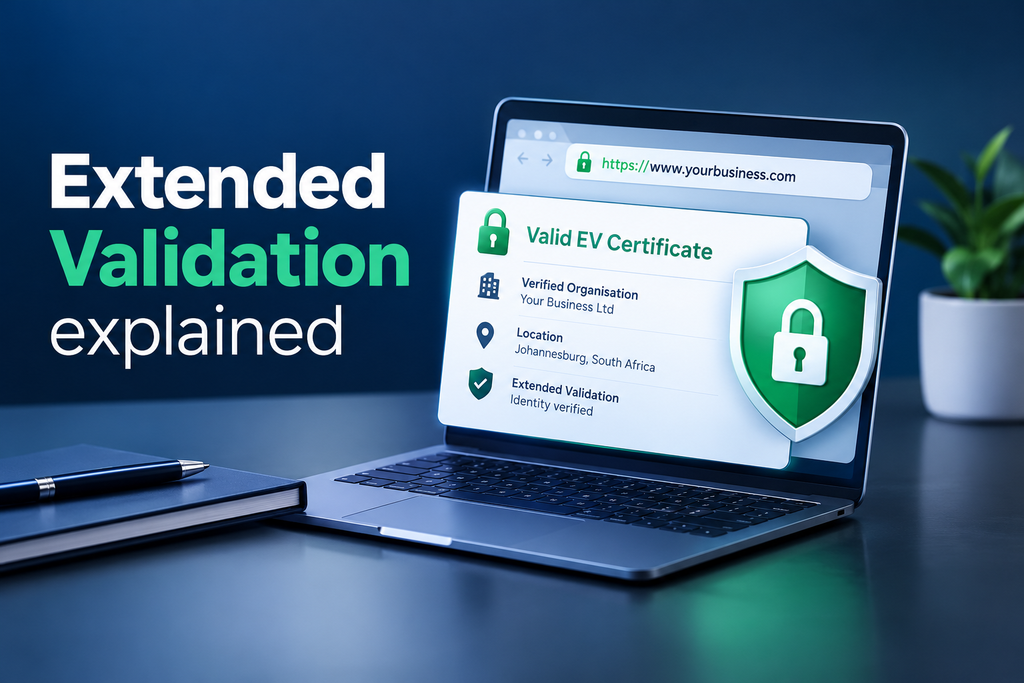
An Extended Validation (EV) certificate sits at the top of the SSL ladder. It carries the strictest checks, the most paperwork and the highest price. For years, it also came with a famous green address bar.
That green bar is gone, which leaves many businesses asking: is an EV SSL certificate still worth it? This guide explains what EV verifies, what changed, who benefits and who doesn’t, and how FastSSLArena helps you make the right call.
What is an EV SSL certificate?
An EV SSL certificate is the highest level of SSL validation. Before issuing one, the certificate authority (CA) runs in-depth checks to confirm your organisation is legitimate, active and authorised to use the domain.
Like every SSL certificate, it encrypts data with the same industry-standard strength. However, what sets EV apart is how thoroughly your identity is verified. For a side-by-side view, read our guide to DV, OV and EV.
What EV checks, beyond OV
EV includes everything in OV validation, plus stricter checks defined in the CA/Browser Forum’s EV Guidelines:
- Legal existence and status. Your organisation must be registered and in good standing.
- Physical existence. The CA confirms you operate from a real business address.
- Operational existence. The CA confirms you’re an active, functioning business.
- Domain rights. The CA confirms your organisation has the right to use the domain.
- Authority of the requester. The CA confirms the people requesting and approving the certificate are authorised to do so.
- Signed agreement. Finally, an authorised person signs the subscriber agreement.
What an EV certificate shows
Click the padlock on an EV-secured site and open the certificate details. You’ll see:
- The organisation’s verified legal name.
- Its country of registration and registration number.
- Its business category and location.
In short, this gives anyone who checks a clear, verified record of who runs the website.
What happened to the green bar?
EV certificates once turned the browser address bar green and displayed the company name beside the URL. It was a striking trust signal.
However, around 2019, major browsers, including Chrome, Firefox and Safari, removed that display. Their research suggested most users didn’t notice it or change their behaviour because of it. Today, EV sites show the same padlock as DV and OV sites. The verified details are still there, but visitors must open the certificate to see them.
As a result, many businesses now question whether EV is worth the cost.
EV certificate pros and cons
| Pros | Cons |
| Highest level of identity verification | No longer visible in the address bar |
| Verified legal details in the certificate | Highest cost of any validation level |
| Makes impersonation harder for scammers | Most paperwork and longest issuance time |
| Meets expectations in regulated industries | Not available as a wildcard certificate |
| Supports enterprise procurement and audits | Same encryption strength as DV and OV |
EV vs OV: what’s the real difference?
| OV | EV | |
| Verifies organisation | Yes | Yes, in more depth |
| Operational and authority checks | Basic | Extensive |
| Details in certificate | Name and location | Name, registration number, jurisdiction and category |
| Issue time | 1–3 days | Several days, sometimes longer |
| Wildcard available | Yes | No |
| Relative cost | Mid-range | Highest |
| Encryption strength | Same | Same |
Who is EV worth it for?
- Banks and financial services, where customers and regulators expect the highest assurance.
- Insurers, fintechs and payment providers that handle sensitive financial data.
- Large online retailers processing high volumes of payments. See our guide to SSL for e-commerce.
- Government and public sector bodies that need verified, traceable identities.
- Brands that scammers often imitate, since every extra barrier to impersonation helps.
- B2B suppliers to large enterprises whose procurement or audit teams check certificate details.
Who probably doesn’t need EV?
- Blogs, portfolios and brochure sites: DV is enough.
- Most small businesses: OV gives verified identity at a lower cost.
- Small online stores using hosted payment pages: OV usually offers the best balance.
- Sites with many subdomains: EV isn’t available as a wildcard, so an OV wildcard is often more practical.
A quick test: is an EV certificate worth it for you?
First, answer these questions. If you say yes to two or more, EV is worth considering.
- Do you handle financial transactions or highly sensitive data?
- Do you operate in a regulated industry?
- Is your brand a common target for phishing or impersonation?
- Do clients, partners or auditors check your certificate details?
- Would a breach of customer trust seriously damage your business?
How to get an EV certificate
- Prepare your documents – Gather your registration details, verified address, listed phone number and details of an authorised signatory.
- Place your order – Next, choose an EV certificate from a trusted brand.
- Submit your CSR and details – Use your exact legal company name.
- Complete validation – Prove domain control, then complete the organisation and authority checks. The CA may also call your listed number and ask for a signed agreement.
- Install and test – Finally, install your certificate and confirm the verified details appear correctly.
Frequently asked questions about EV SSL certificates
Does an EV certificate give stronger encryption?
No. EV, OV and DV certificates all use the same encryption. Instead, EV adds deeper identity verification.
Does EV improve my Google ranking?
No. Although Google rewards secure HTTPS sites, it doesn’t rank EV above other certificate types.
Why did browsers remove the green bar?
Browser makers found that most users didn’t notice or rely on it. As a result, they now show the same padlock for all valid certificates.
Can I get an EV wildcard certificate?
No. Industry rules don’t allow EV wildcards. However, you can get EV on a single-domain or multi-domain certificate.
How long does EV validation take?
Usually several days. Still, having your documents ready and your authorised contact available speeds it up.
How FastSSLArena helps you decide on EV
Because EV is a significant investment, it should be the right one. For that reason, FastSSLArena gives you honest advice and makes the process smooth.
- Straight answers. We’ll tell you whether EV makes sense for your business, or whether OV will do the job.
- Trusted EV brands. Compare EV certificates from DigiCert, Sectigo, Thawte and GeoTrust in one place.
- Document preparation. We help you gather the right details upfront, so validation doesn’t stall.
- Validation support. We guide you through each check and help resolve any queries from the CA.
- Protection while you wait. Meanwhile, secure your site with a fast DV certificate during EV validation.
- Discounted pricing. Get top-level validation at competitive rates.
Make the right call on EV with expert help. Talk to FastSSLArena today.