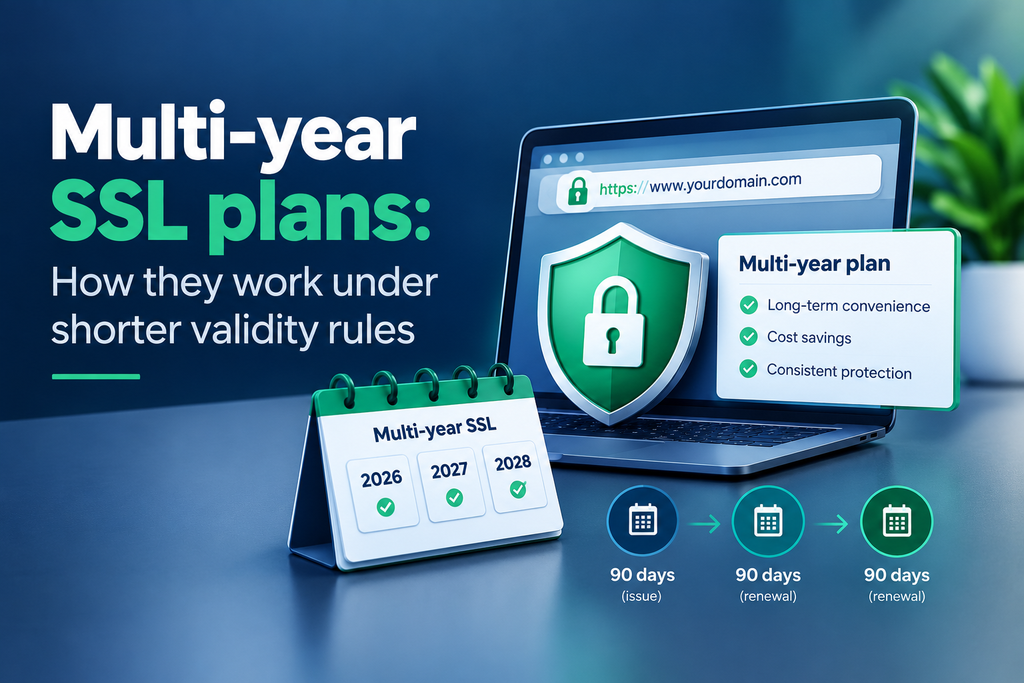
Not long ago, you could buy an SSL certificate, install it and forget about it for a year or more. Those days are over. Industry rules are cutting certificate lifespans in stages, and by 2029 a certificate will last just 47 days. So where does that leave multi-year SSL plans?
They still exist, and they can still save you time and money. This guide explains how they work under the new rules, what you gain, what to watch for, and how FastSSLArena keeps it simple.
What’s changing: shorter certificate lifespans
The CA/Browser Forum, which sets the rules for trusted certificates, has approved a phased reduction in maximum validity:
| Certificates issued from | Maximum validity |
| Before 15 March 2026 | 398 days |
| 15 March 2026 | 200 days |
| 15 March 2027 | 100 days |
| 15 March 2029 | 47 days |
The goal is better security. In particular, shorter lifespans limit the damage if a private key is stolen and keep encryption up to date. However, the trade-off is more frequent certificate replacements.
What is a multi-year SSL plan?
A multi-year SSL plan is a subscription, not a single certificate. You pay once for coverage over a set period, such as two or three years. During that time, you receive as many certificates as you need to stay covered.
Because no single certificate can last longer than the current maximum, your plan replaces each certificate before it expires. These replacements are called reissues, and they’re usually included in your plan at no extra cost.
How a multi-year SSL plan works, step by step
- Buy your plan. Choose your certificate type, brand and plan length.
- Get your first certificate. Complete validation, and your first certificate is issued for up to the current maximum validity.
- Reissue before expiry. Then, before that certificate expires, you request a new one under the same plan. You generate a new CSR, complete domain validation and install it.
- Repeat through the plan. This cycle then continues until your plan ends.
- Renew your plan. Finally, when the subscription period finishes, renew for another term.
How many certificates will your plan include?
As lifespans shrink, each plan needs more reissues. Here’s a rough guide:
| Plan length | At 200 days | At 100 days | At 47 days |
| 1 year | About 2 | About 4 | About 8 |
| 2 years | About 4 | About 8 | About 16 |
| 3 years | About 6 | About 11 | About 24 |
These figures are illustrative. In practice, you’ll reissue a little early each time, and a plan that spans a rule change will mix certificate lengths.
The benefits of multi-year SSL plans
- Lock in your price. Protect yourself from future price increases for the whole term.
- Save with longer terms. Multi-year plans often cost less per year than buying annually.
- One purchase, one approval. Ideal for businesses with annual budgets or slow procurement processes.
- Reissues included. Get every replacement certificate you need without paying again.
- Less admin. No need to place a new order each time a certificate expires.
The trade-offs to know
- You still need to install each certificate. A plan covers the cost, not the work, so each reissue must be installed on your server.
- Validation happens more often. Domain control must be re-checked regularly. CAs can reuse your organisation details for a limited time, but that window is also shrinking. Our guide to OV SSL validation explains what’s involved.
- You’re committed to one brand and product. As a result, switching mid-plan usually means buying a new certificate.
- Higher upfront cost. That’s because you pay for the full term at the start.
- Missed reissues still cause outages. If you forget to replace a certificate, you’ll face an expired certificate even though your plan is active.
Why automation matters more than ever
With certificates soon lasting just weeks, manual replacement becomes a real burden. Automation, however, solves this.
- ACME automation. Many CAs and hosting providers support ACME, a protocol that requests, validates and installs certificates automatically.
- Certificate management tools. Dashboards track every certificate and flag upcoming reissues.
- Reminders as a fallback. If you can’t automate, set alerts at least 30 days before each certificate expires.
Pairing a multi-year plan with automation gives you the best of both: a locked-in price and hands-free replacements. Read our guide to SSL renewal and maintenance.
Who should consider a multi-year SSL plan?
| Good fit | Less suitable |
| Businesses with stable websites and domains | Startups whose domains or brands may change |
| Organisations with annual budgets | Businesses that want maximum flexibility |
| Teams using automation or management tools | Teams with no capacity to handle reissues |
| Companies managing several certificates | Short-term projects or campaign sites |
Tips for getting the most from your plan
- Automate wherever possible. Let ACME or your provider handle reissues.
- Track every reissue date. Keep a simple list or use your provider’s dashboard.
- Generate a new private key each time. After all, a fresh key with every reissue limits risk.
- Keep your details current. Otherwise, outdated contact emails or company details slow validation.
- Use a shared inbox. Send reissue notices to an address that doesn’t depend on one person.
Frequently asked questions about multi-year SSL plans
Are multi-year SSL certificates still allowed?
Single certificates can’t last multiple years, but multi-year plans still can. They cover a long period by issuing a series of shorter certificates.
Do I pay for each reissue?
Usually not. Reissues are typically included in your plan at no extra cost, but check your provider’s terms.
Do I need a new CSR for each reissue?
It’s strongly recommended. That’s because a new CSR creates a fresh private key, which keeps your site more secure.
What happens if the rules change during my plan?
Your plan continues. Your certificates are simply issued with the shorter maximum validity, so you reissue more often.
Can I switch brands during a multi-year plan?
Usually not without buying a new certificate. So choose your brand carefully before committing to a long term.
How FastSSLArena helps with multi-year SSL plans
Shorter validity rules don’t have to mean more stress. FastSSLArena helps you lock in value and stay covered.
- Multi-year plans at discounted rates. Lock in competitive pricing on DigiCert, Sectigo, Thawte, GeoTrust and RapidSSL.
- Reissue tracking. See when each certificate is due for replacement, so nothing slips through.
- Built-in CSR tool. Generate a fresh CSR and private key for every reissue in a few clicks.
- Validation support. We guide you through repeat domain and organisation checks.
- Installation help. Get support installing each new certificate correctly.
- Automation guidance. We’ll help you understand whether automated renewal suits your setup.
Lock in your price and stay protected, however short certificates get. Explore multi-year SSL plans at FastSSLArena today.